
 Image: Mika Baumeister
Tipping Points Summer Show
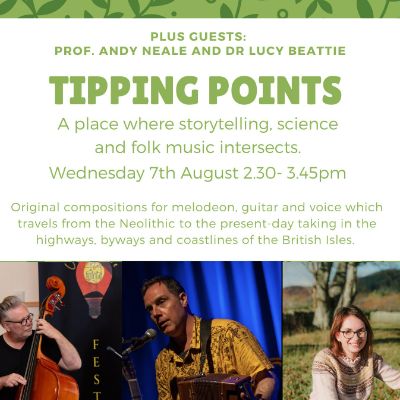
As Luke shared the opening notes of Sun Stations the opener for Tipping Points; the crowd, a blend of musicians, curious festival-goers, and country folk fell silent, but soon as the melodeon and guitar began weaving together strands of music and story they were joining in with the songs in perfect harmony.
This wasn’t just a folk show; it was a fusion of song, storytelling, and science. Tipping Points was conceived in 2022, inspired by the paper published by Armstrong McKay et al. (2022) Exceeding 1.5°C global warming could trigger multiple climate tipping points. Following workshops in Iceland, Rotterdam and Oxford Luke and I collaborated with agricultural microbiologist Professor Andy Neal to create a unique performance exploring the delicate interactions between society and the environment through folk traditions in farming.
As the melodies drift from Neolithic times to modern-day, the music paints vivid portraits of farmers and fisherfolk who have lived through shifting climates, economic pressures, and environmental changes. The performance draws on the rich traditions of English and Scottish folk music, and it felt at home in Devon - particularly in the bucolic setting of the Dartmoor Folk Festival, just as it had in Wester-Ross and Oxfordshire, each place offering new stories and insights into the resilience of rural communities.
Climate communication, has to be more than facts and figures presented fleetingly on the television news or a telephone screen. It needs to be a dialogue, a two-way street where audiences don’t just passively listen but actively engage.
Folk music and storytelling provide a platform where people from all walks of life can connect with complex scientific issues on a personal level. When audiences hear tales of ancient communities responding to environmental shifts or see parallels in their own lives, it sparks a deeper understanding of the challenges we face today. Climate change becomes more than a distant or abstract concept—it becomes grounded in lived experience.
As a social scientist, I am inspired by this blend of folk traditions and science to explore new ways of communicating climate issues. I believe that storytelling and music offer invaluable tools for engaging wider audiences—particularly those who might feel alienated by traditional climate discourse. Folk music, with its long history of narrating the lives of ordinary people, provides a bridge between the past and present, between communities and the scientific data that shapes our understanding of the world.
To instantiate climate action, we need more than just the bare facts, humans need to connect with the heart. Although there is consensus on much of the science around the causes of climate change there are still people who are not ready to take this on board, or who think it is something that will not directly affect them. When we left the stage at Dartmoor two or three people came up with tears in their eyes inspired by the show, and inspired to action - whether that was to get back to growing veg in a "no-dig" garden, or to take action to make a better life for their grandchildren.
Back in Scotland I talked about Tipping Points with some wise friends whom I knew for years through my work with the Scottish Crofting Federation. They shared the work of Joanna Macy with me. Her approach, known as "The Work That Reconnects," fosters emotional engagement with ecological crises, encouraging individuals to transform despair into action. By connecting heart and ecology, Joanna Macy advocates for personal empowerment and collective responsibility in addressing environmental and social challenges. I'm keen to learn more and see how this can add new dimensions to the Tipping Points project.
